There is a particular kind of glance a barista gives you at half past twelve. You have been at the window table since ten. Your flat white went cold about an hour ago. There is a couple by the door holding trays, scanning the room for somewhere to sit.
Nobody says anything. Nobody needs to.
Working from cafés is one of those arguments that never quite ends. Some owners have started banning laptops at lunchtime. Remote workers point out that the café has plugs, Wi-Fi and a lot of empty chairs at three in the afternoon. Both sides are partly right, and most of the heat comes from not knowing the numbers.
So I looked them up. What does it actually cost a café when you charge your laptop for three hours? How much of your £3.80 does the café keep? And what do you bring them that does not show up on the till receipt?
The short version:
- Charging a laptop for three hours costs a café about 1p to 7.5p in electricity.
- From a £3.80 flat white, the café keeps roughly 25p to 65p as profit.
- A seat in a typical London café costs it about 46p an hour in rent alone.
- So one coffee covers your chair for about an hour. At quiet times you are welcome to stay longer; at lunchtime, buy lunch or move on.
The bit everyone worries about: the electricity
Let's get this one out of the way, because it is the smallest number in the whole debate.
According to the government's latest figures, the smallest UK businesses paid an average of 38.4p per kWh for electricity in spring 2026, and slightly larger ones about 28.6p. A small café sits firmly in the first group, so I have used 38.4p. That is generous to the café.
A modern laptop uses far less power than its charger suggests. A MacBook Air draws around 8–10 watts doing ordinary work, and its charger tops out at 30 watts. Bigger Windows laptops often come with a 65-watt charger.
Here is what three hours plugged in actually costs:
- MacBook Air, normal work (about 10 W): 0.03 kWh, which is about 1p
- Any laptop charging flat out at 30 W: 0.09 kWh, which is about 3.5p
- A big 65 W laptop at full power the whole time: 0.195 kWh, which is about 7.5p
- Topping up your phone from empty: a little over half a penny
Even the worst case is about 2% of the price of the coffee. Wi-Fi costs the café the same whether one person uses it or twenty.
If you have ever felt guilty about the plug, you can stop. The electricity is not the cost. The chair is.
Whether the plug works at all is a different question. About one in three plug reports on Findy say it didn't, and the reasons café plugs fail are mostly about policy and timing, not broken sockets.
Where your £3.80 actually goes
The average UK flat white was £3.23 in 2024, up 22p in a year, and London is dearer. Big chains now charge £5 or more for a large one. I have used £3.80 as a typical London independent price.
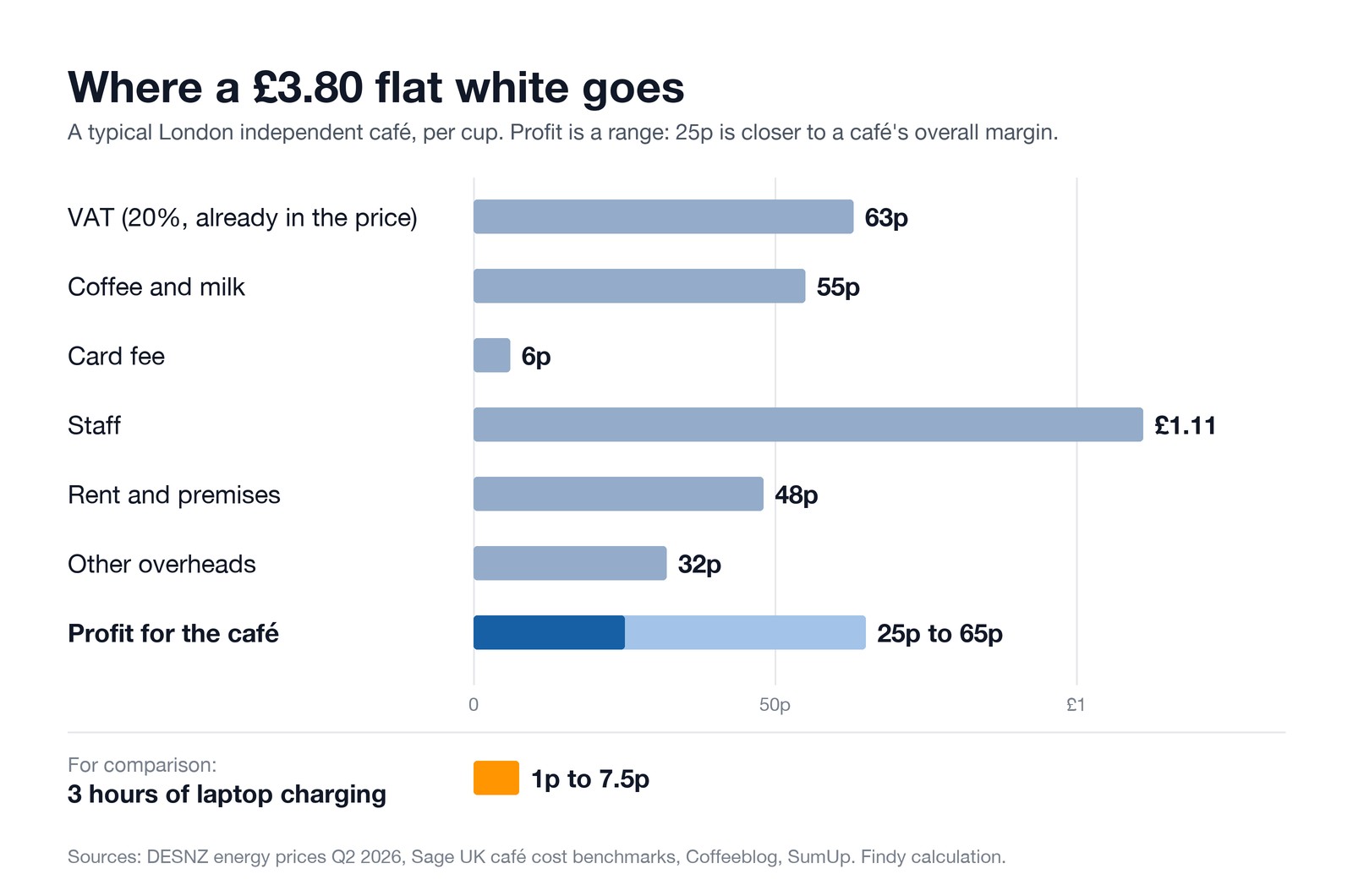
Here is the journey of that £3.80:
- VAT: 63p. Hot drinks are charged VAT at 20%, and it is already inside the price. The café starts with £3.17.
- Coffee and milk: about 55p. Good beans and dairy milk run from roughly 34p to 75p per flat white.
- Card fee: about 6p. A typical small-business card reader charges around 1.7%.
That leaves about £2.56. It looks like a healthy margin, and this is where most people stop counting. But the café still has to pay everyone and everything else out of it.
UK café owners usually aim to keep staff costs to about 30–35% of sales, rent to about 15%, and other overheads to around 10%. Apply those to your coffee and you get roughly:
- Staff: £1.11
- Rent and premises: 48p
- Lighting, heating, insurance, repairs, software and the rest: 32p
What is left, the actual profit on your flat white, is somewhere between 25p and 65p. The lower figure is closer to what a well-run independent café makes across everything it sells. A good year means keeping around 8–12% of takings.
To put that in human terms: the National Living Wage went up to £12.71 an hour in April 2026. Add employer National Insurance and one barista costs the café roughly £14 to £15 an hour. The café needs to sell around five or six coffees an hour just to cover one person behind the counter, before rent, before beans, before anything else.
What a seat costs per hour
So the real question is not the plug. It is the table.
Take a fairly ordinary London café: a 1,000 square foot unit on a neighbourhood high street. The average London shop rent was about £50 per square foot a year when it was last surveyed borough by borough, from £23 in Barking and Dagenham to £86 in Kensington and Chelsea. It has gone up since. At £50, that café pays £50,000 a year in rent alone, before business rates.
Say it has 30 seats and is open ten hours a day for about 360 days a year. That is 108,000 "seat-hours" a year.
£50,000 ÷ 108,000 = about 46p per seat, per hour. In rent alone.
Now line those two numbers up. One coffee leaves the café with 25p to 65p of profit. Your seat costs it about 46p an hour in rent.
One coffee pays for your chair for about an hour. After that, on paper, you are being subsidised.
So it is unfair, then?
Not quite. That 46p is an average, and cafés do not live on averages.
At ten past three on a wet Tuesday, half the tables are empty. The rent is paid either way. The barista is there either way. Your second hour costs the café almost nothing, and your coffee is money it would not otherwise have had.
At half past twelve on a Saturday, it is the opposite. Someone who wanted lunch walked back out because you were there, and they would have spent several times what you did. That is the moment owners mean when they talk about "table hogging", and it is a fair complaint.
When the BBC spoke to cafés bringing in laptop rules in 2024, the reasons were almost entirely about busy times. The Collective in Caversham banned laptops from 11:30 to 1:30 on weekdays and all weekend. Milk and Bean in Newbury set a one-hour limit on weekdays and no laptops at weekends. Its owner said laptop users bring "lower turnover and quite a low spend". Neither banned laptops at three o'clock on a Tuesday.
The question is not "is working from a café fair?" It is "is it fair right now?"
What you bring that the till does not count
There is a proper piece of research on this. In 2021, Laetitia Mimoun and Adèle Gruen published a study in the Journal of Service Research. They spent time in 38 London venues where people work, including coffee shops, pubs, hotel lobbies, museums, libraries and stations, and interviewed both the workers and the people who run the places.
They found that people working from cafés are not just the stereotype of a student nursing one drink all day. They can be genuinely valuable to the business, in a few ways:
- They fill the quiet hours. Customer-workers tend to turn up off-peak, giving the café "a steady source of income in otherwise quiet periods".
- They come back. Most of the people they interviewed went to the same place every week. Regulars are the most valuable customers a small café has.
- They come back for other things. People who work somewhere during the day return in the evening or at the weekend to eat, drink and bring friends.
- They make a room feel alive. As one manager put it, "a busy café is better than an empty café". Nobody wants to walk into a silent, empty room.
- They are free marketing. One café owner described laptop customers as "a marketing budget effectively". They post photos, leave reviews and recommend places to colleagues.
The same research found the friction too. A waitress described a regular who would stay two hours on one coffee while new customers had nowhere to sit. Both things are true at once.
Some places have simply put a price on it. One London pub owner in the study offered a nine-to-five table for £10, with a couple of coffees included. Nobody has to feel awkward, the staff do not have to keep checking, and the pub earns from the empty hours.
A fair way to work from a café
Here is the rule of thumb I use. It is not a law, just the numbers above turned into habits.
- Buy something roughly every hour and a half. One purchase covers your seat for about an hour at an average café. At quiet times it covers far more than that.
- Stay out of the lunch rush, or join it. Between about 12 and 2, either order lunch like everyone else or pack up. If there is a queue and you are in your second hour, that is your cue.
- Take the small table. A laptop does not need a table for four.
- Charge without guilt. Three hours of power costs the café pennies. Just do not trail a cable across the walkway.
- Go back. Being a regular is worth more to an independent café than any single order. Learn their quiet hours and use those.
- Make the time count. Two focused hours beat a whole day of half-work. Our three-hour café session is built around exactly that.
- Leave a review. If a café made your working day better, saying so in public is worth more to them than another flat white.
If you want the longer version of the manners side, from calls to cables to Wi-Fi, read our café etiquette guide for remote workers.
Why we built Findy around local cafés
Findy started from a selfish problem: finding somewhere in London to work where the plugs actually work. But the longer we have run it, the more it has become about the cafés themselves.
Big chains do not need help being found. The independent place two streets away, with good coffee, decent sockets and empty tables at three o'clock, often does. That is the café the numbers in this article are really about. A small place where 25p of profit on a coffee is the difference between a good month and a bad one.
Here is what Findy does about that:
- It puts local cafés on the map next to the big names, so people working nearby discover them instead of walking straight to a chain.
- It shows which places welcome laptops and whether the plugs work, using reports from people who have just been there. You end up at cafés that want you, rather than ones that have put up a "no laptops" sign. Here is how to find a laptop-friendly café near you.
- Anyone can add a missing café in under a minute. If your local is not on the map, add it. Every independent on Findy is one more place a remote worker might become a regular at.
- Every report makes it better for the next person. One tap after your visit, "plugs worked" or "they didn't", keeps the map honest for everyone.
Here are a couple of independents from the map worth a visit at a quiet hour:
Millfields Coffee: live plug status on the Findy map
Hackney Coffee Company: live plug status on the Findy map
The short answer
Is it fair to work from a café on one coffee? For an hour, yes, comfortably. For a quiet afternoon, mostly yes, and the café is probably glad of you. For a three-hour stint through Saturday lunch, no, and you already knew that.
The electricity was never the issue. Three hours of charging costs less than the sugar sachet. What matters is the chair, the time of day, and whether you come back.
So buy the second coffee. Get the cake. Go at three o'clock. And when you find a good local café, tell people. That is how you make sure it is still there next year.
Find a laptop-friendly local café near you on the Findy map, or browse our guide to laptop-friendly cafés in London.
Frequently asked questions
Is it rude to work on a laptop in a café?
Not in itself. Most cafés with sockets and Wi-Fi expect some laptop customers, especially at quiet times. It becomes a problem when you hold a table through a busy period without buying much. If you are not sure, ask the staff when you order.
How long can you stay in a café with one coffee?
About an hour is a fair guide. One coffee leaves a typical café 25p to 65p of profit, and a London seat costs it about 46p an hour in rent. To stay longer, buy a second drink or something to eat roughly every 90 minutes, and avoid the lunch rush.
How much does it cost a café to charge my laptop?
Very little. Three hours of charging uses about 0.03 to 0.2 kWh, which is roughly 1p to 7.5p at the 38.4p per kWh that very small UK businesses pay. Charging a phone costs less than a penny.
How much profit does a café make on a coffee?
On a £3.80 flat white, after VAT (63p), coffee and milk (about 55p), the card fee, staff, rent and overheads, a café keeps roughly 25p to 65p.
Why do some cafés ban laptops?
Mostly to free up tables at busy times. Cafés that have brought in laptop rules usually limit them at lunchtime and at weekends, when someone holding a table can mean a lunch customer walking back out.
How can I support local cafés when I work from them?
Go at quiet times, buy something every hour or so, become a regular, leave reviews, and add missing independent cafés to the Findy map so other remote workers can find them.
Sources
- Mimoun, L. and Gruen, A. (2021), "Customer Work Practices and the Productive Third Place", Journal of Service Research, 24(4), 563–581
- BBC News (September 2024), reported via Outsource Accelerator: café laptop restrictions in Caversham and Newbury
- Energy Plus, quoting DESNZ Quarterly Energy Prices (Q2 2026): small business electricity prices
- Ecocostsavings: laptop power consumption
- Coffeeblog: cost of coffee and milk per cup
- Sage: UK coffee shop costs and margins
- Real Business Rescue: London retail rents by borough (2022 survey)
- ACS: National Living Wage from April 2026
- SumUp: UK card payment fees
- Matthew Algie pricing survey and The Spectator: UK flat white prices