You found the café. You found the table. You plug in — and nothing happens.
It is one of the small, specific frustrations of working away from a desk, and it is more common than you would think. We looked at every plug report the Findy community has filed so far: 56 reports across 12 London venues. 36 said the power was working. 20 said it was not.
That is roughly one in three. The sample is still small and early, so treat the exact figure loosely — but the reasons behind those 20 failures are consistent, and they are worth knowing before you carry a laptop across London.
What actually goes wrong
Every report includes a reason. Here is the full breakdown of the 20 failures:
- No power at the socket — 6 reports
- Staff say the sockets are unavailable — 6 reports
- The area with the sockets is closed — 4 reports
- The port itself is broken — 2 reports
- Every outlet is already taken — 2 reports
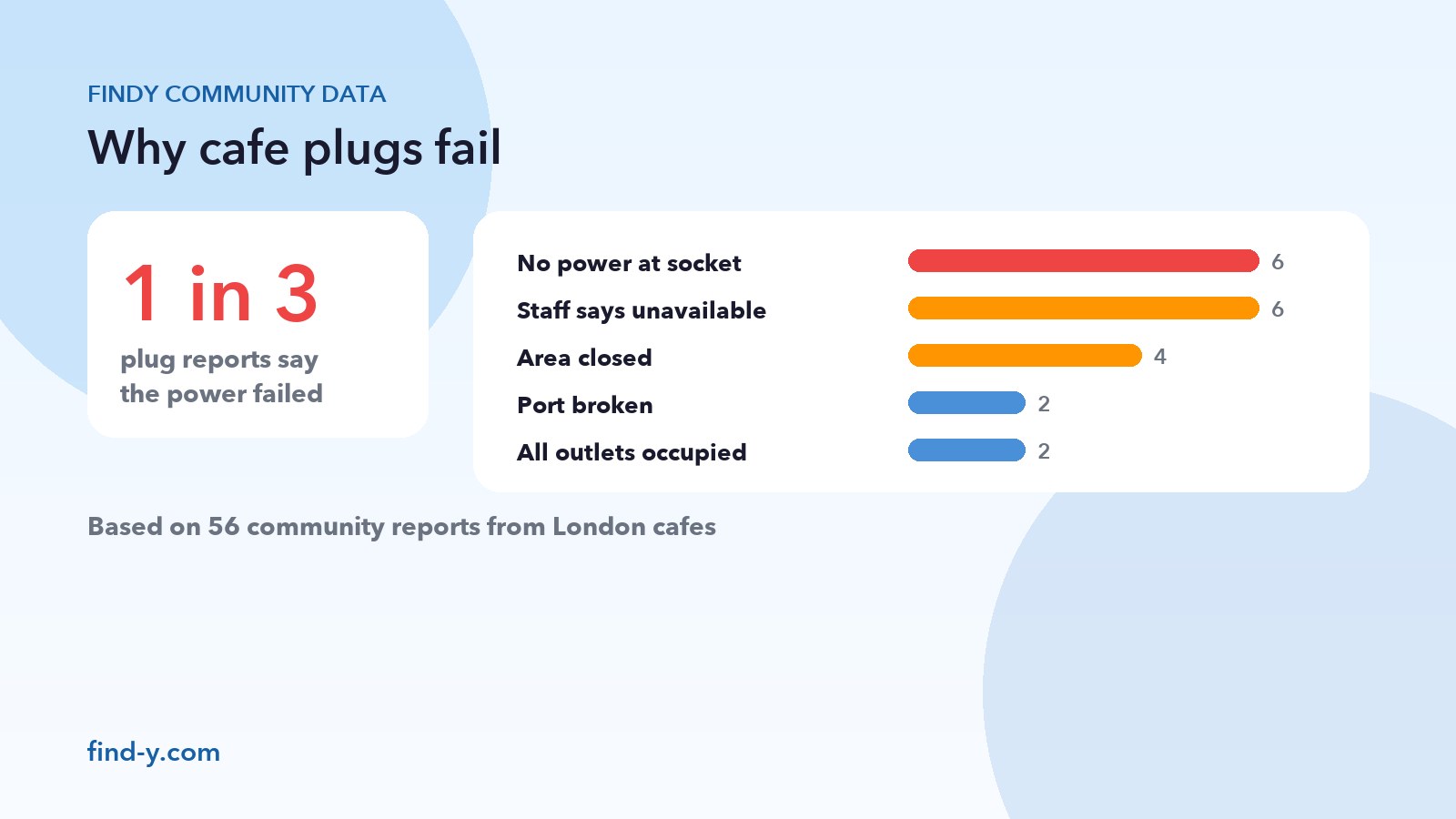
Notice what this list is not. Only two of the twenty were a physically broken socket. The rest were about policy, layout and timing — things that no amount of staring at a photo on a listing page will tell you.
1. The socket is dead (6 reports)
The most common failure, and the most invisible. The socket is there on the wall, it looks perfectly normal, and nothing comes out of it. Often these are sockets that were switched off at the fuse board a long time ago, or that were installed for a floor polisher rather than a customer.
What to do: test before you commit. Plug in and watch for your charging indicator before you take your coat off and order. If it is dead, you have lost ten seconds rather than an afternoon.
2. Staff say you cannot use them (6 reports)
Equally common and far more awkward. The sockets work, but the café would rather you did not use them — usually during a busy period, sometimes as a blanket rule. This is entirely their call. A café's margin on one flat white does not cover a four-hour table.
What to do: ask at the counter when you order, not after you have settled. "Is it alright if I plug in?" takes three seconds and saves the conversation where someone has to come and ask you to unplug.
3. The part of the room with sockets is closed (4 reports)
Lots of cafés put their power along a back wall, in a basement, or upstairs — exactly the areas that close when the café is short-staffed, or outside peak hours. The venue is open. The plugs are behind a rope.
What to do: if a place is known for a downstairs or upstairs work area, go earlier rather than later, and glance at the stairs before you order.
4. The port is broken (2 reports)
Genuine physical damage: a cracked faceplate, a USB port that has been pushed in once too often, a loose socket that drops your plug out whenever the table is knocked.
What to do: carry your own plug rather than relying on a café's USB port. A standard three-pin socket is far more likely to work than a built-in USB that a thousand people have poked at.
5. Every outlet is taken (2 reports)
Nothing is broken. You are simply late. Two reports is the smallest category here, but anyone who has walked into a café at 10am on a Tuesday knows the feeling.
What to do: this is the one that timing fixes. See the three-hour café session for how to pick a slot where you are not competing for the wall.
Why listings cannot tell you this
Here is the thing that connects all five: four of them can be true at a café that genuinely has sockets. The power exists. It is just not available to you, today, at this hour, at this table.
That is why a static list of "laptop-friendly cafés" goes stale so quickly. It can tell you a place has plugs. It cannot tell you the back room is shut, or that the manager stopped letting people charge during the lunch rush.
The only thing that keeps that current is people reporting what they actually found. That is what Findy's confidence score is built on — recent reports count for more than old ones, so a venue that was working this morning ranks above one that worked last month.
A thirty-second routine that avoids most of this
- Check before you travel. Look at the venue on the map and see whether anyone has confirmed it recently.
- Ask while you order. One sentence, at the counter, before you commit.
- Test before you settle. Plug in, watch for the charging light, then unpack.
- Have a second option. Know the next café along the same street, so a dead socket is a five-minute inconvenience.
Across 1,300 venues on the map in London, there is almost always another option within a few minutes' walk — the denser areas like SE1, NW1 and the City have dozens within the same postcode.
Report it, even when it works
Thirty-six of these fifty-six reports were someone tapping "it works now" on a venue they were sitting in. That takes a couple of seconds and it is the single most useful thing you can do for the next person.
The failures matter just as much. A report that says staff said no saves somebody else the walk.
Open the map and have a look at what is near you. If you end up somewhere with a working socket, tell the next person.